
When a two-spoor track is closed
As part of an adventure circling through Zimbabwe, I drove on a track through the Nyanga National Park, in the Eastern Highlands of this incredible country. Here, on this Low-Range track winding up through a landscape I later saw in the familiar Grand Tour Special, I learned the value of being prepared, and how awesome people are despite a language barrier.
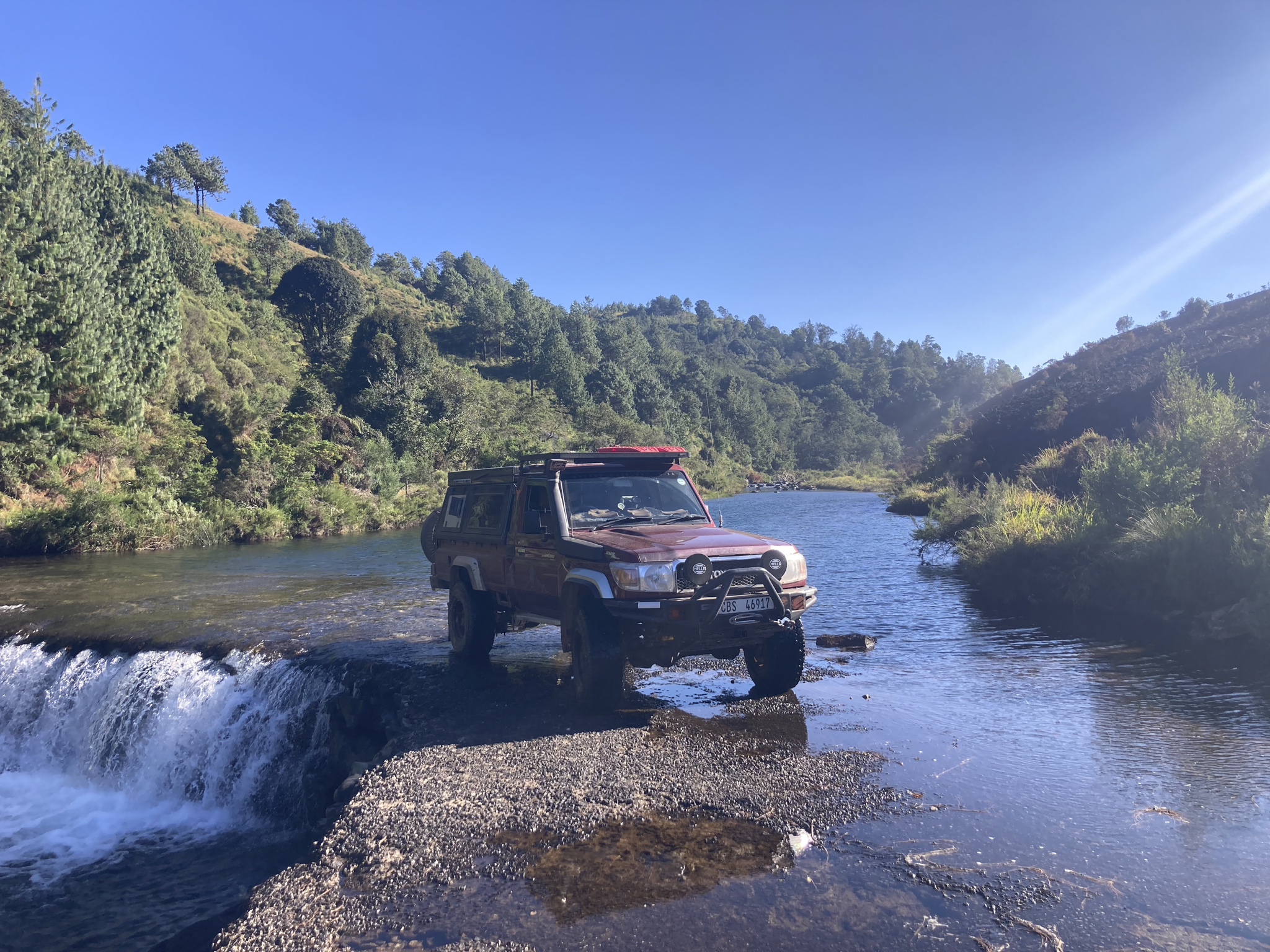
Posing for a picture on a crossing over the Pungwe River. This is the start at the Southern point of the Nyanga National Park.
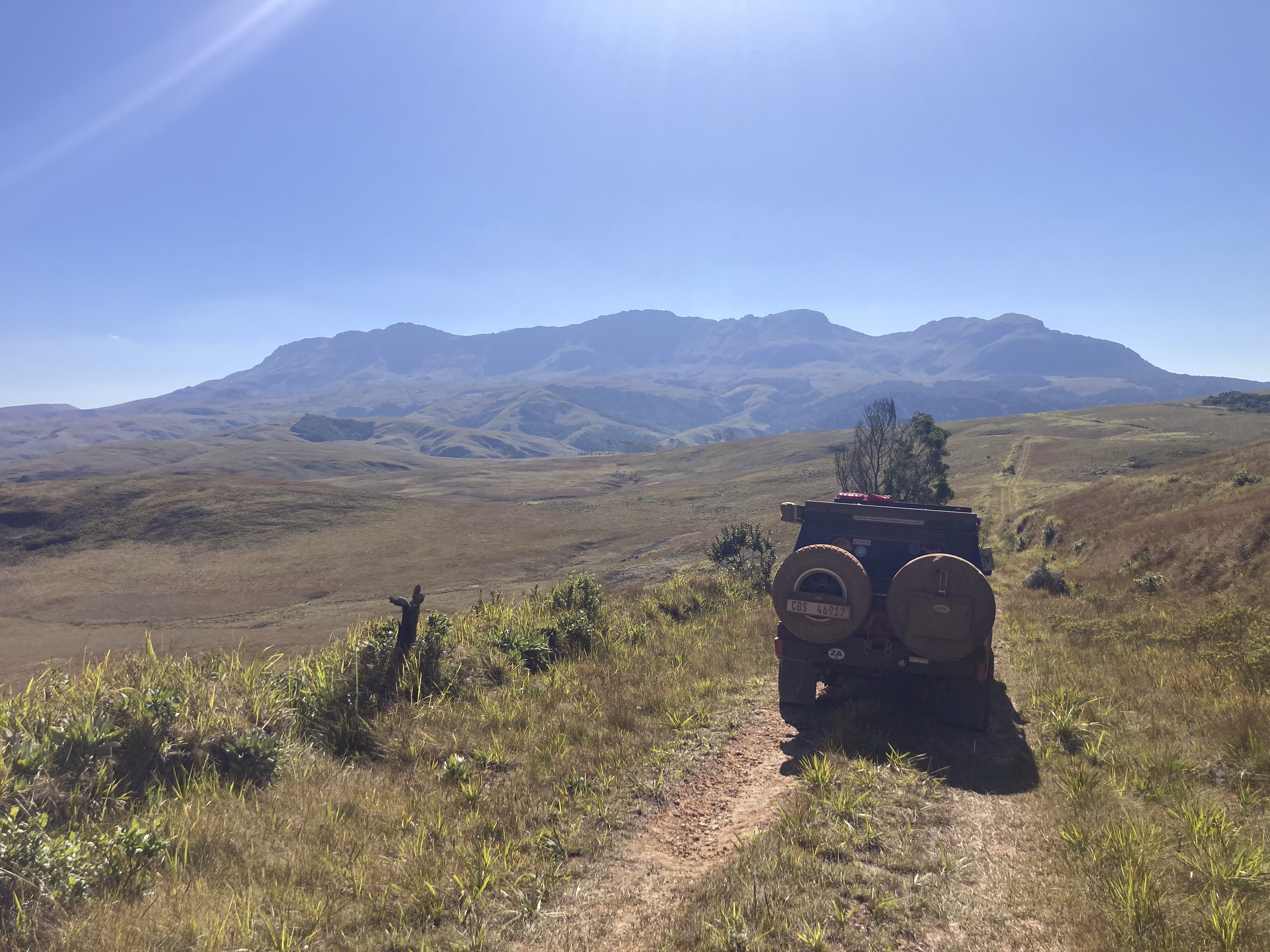
The drive up to the Mt. Nyangani mountain range.
I started early in the morning, leaving from the Far and Wide cottages. I camped on their grass, as they weren't actually taking any guests and I didn't make a formal booking. An awesome place, high up in the mountains overlooking the Honde Valley.
The previous day I walked across the Mutarazi Falls on the suspension bridge. This is second highest waterfall in Africa, Zim's highest at around 770m. Looking out over the valley below makes one realize just how small you actually are and how there is often more to appreciate in a region than we realize.
Today though, the plan was to reach the northern exit of the Nyanga National Park. The Park is focused around Mt. Nyangani, standing at 2592m high. It's the highest point of Zimbabwe, and is surrounded by grass plains with patches of Pine, Wattle, Acacia and dwarf Msasa tree forests. There are game animals and predators like Leopards, but for me the Park stood out because of the incredible landscape. It was literally like driving through a wallpaper. And the tracks were awesome, proper 4WDriving.
At about 08h30 I arrived and checked in at the Park entrance. Friendly as everyone I encountered along the way, the Park Ranger wished me well and I headed into the Park on the two-spoor track.
The track followed the curves along the hills as you gain altitude, crisscrossing from the edges to the inner plateau. You keep on climbing towards Mt.Nyangani until you reach the bottom edge of the mountain range. Here, you make an almost 90 degree turn to the left (North East), and drive clock-wise around the bottom of the mountain, with the peak towering over from the right.
Along the way I saw a few small buildings. They looked like small single room houses with a couple of windows, but they were tired. I guess you could live in them but they didn't look like they were permanently used. I also didn't see anyone.
Up to this point, I'd been driving in 4x4 all the way. For the most part it wasn't necessary, but the steep parts justified Low-Range as the drop-off was serious and the surface was loos-ish rocks and dirt. As ever, Low-Range provided control as traction broke now and then. After the 90 degree bend, the driving became more and more slow-going.
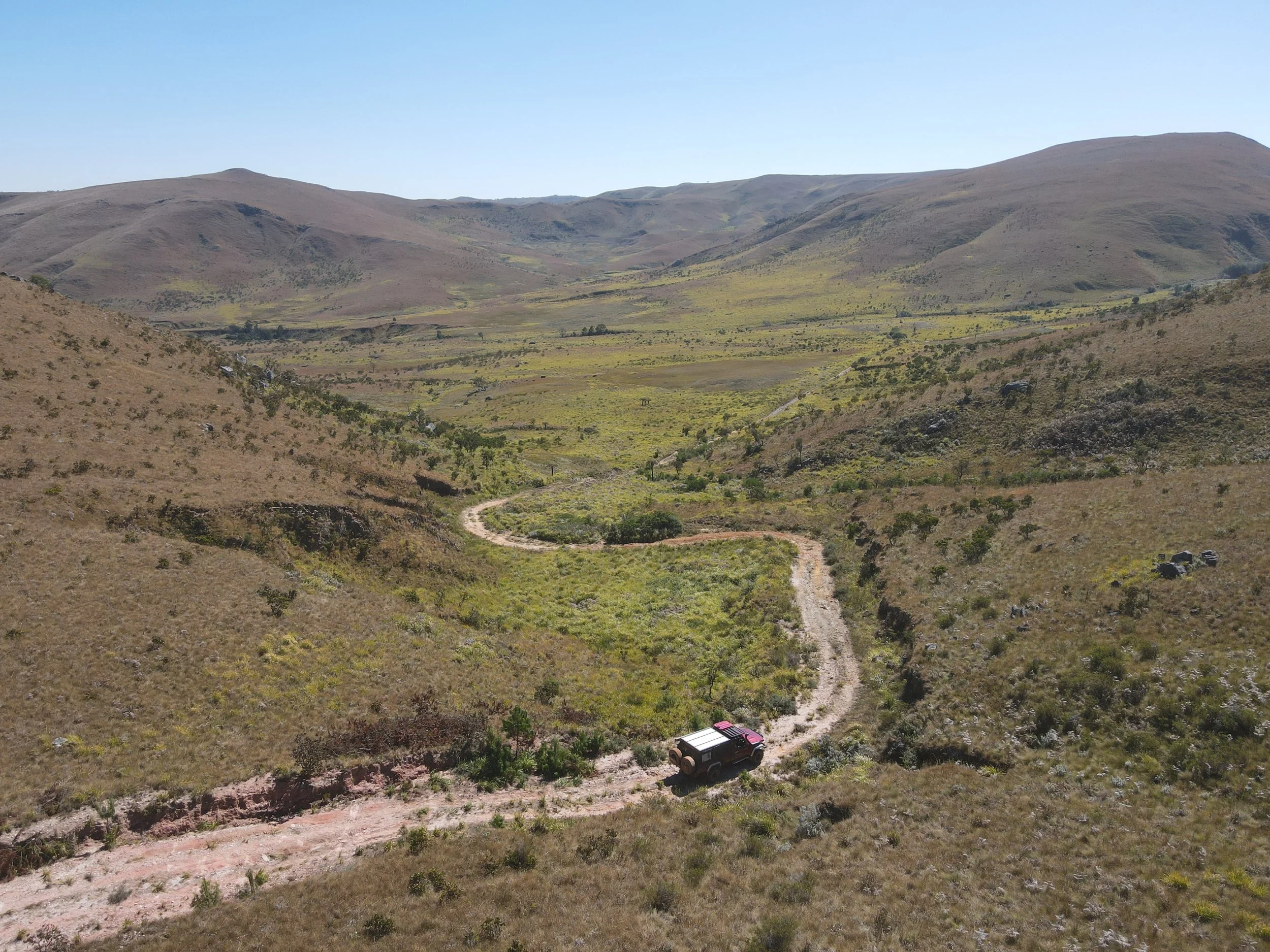
A view of the landscape as the track winds through the mountains.
Over the 3 or so kms to the next turnoff I crawled through some washed-out streams and some larger more technical rocky sections, but my attention was drawn next to the tracks. Every few-hundred meters I saw a pile of construction wooden beams. They were at least 6 meters long, and given their quantity I worked out that they weren't unloaded from a pickup. They definitely came off a 10-ton truck or something to that effect. My speculation turned to realization as I rounded a corner and the bushes gave way to a massive flatbed truck in the middle of the road.
Judging by the angle of the rear-axle I worked out why they had unloaded the material along the way. The axle was turned by about 20 degrees relative to the chassis. It had broken completely free from its mounts and meant that the truck couldn't move.
As I got out, I walked to the truck to meet with the 8 gentlemen who looked like they were waiting with the truck for help to arrive. They were resting in the shade of the truck and along the upper ditch next to the broken truck. I greeted them and they nodded back. One guy came up to me and said that they don't understand any English. He understands a little bit. We mostly exchanged the words "Yes", "here" and hand signals until the end.
As I walked around the truck trying to figure out a way for me to get around, I became aware that turning around wasn't an option. It was past mid-day and I wouldn't reach the entrance gate in time. Also, it would cost valuable time in trying to reach the Gairezi river to the North of the Park over the following days. Next to the truck there wasn't a lot of room, and it was covered by thick bush. The ground sloped off and was muddy due to the stream coming down through the under-growth.
While I worked out a possible driving line with the "no turning around" feeling in the back of my mind, the guys started clearing the area next to the truck. I didn't ask them to do this, nor did the gentleman that I could kind-of communicate with. I walked back to my truck to work out how far I could go on my way back to the entrance, "where I could stop and put up my tent" type of idea. And these guys just started to clear the bushes and undergrowth for me to drive past, no issues, no requesting anything or something to say thanks, they just started clearing the track out of their own.
I brought my shovel and traction boards to help move the thicker bushes and lay them down over the sharp roots that would no doubt puncture a tire like a large, upturned bolt. You can only move and cut the bushes so much, meaning that their sharp low-down branches and exposed roots were just looking for a piece of rubber to greet. After we did our best to smooth out the pathway, I launched the drone and had a go.
I crawled past until I reached the cab of the truck. The Land Cruiser stopped moving and I got out. It didn't take much to work out the problem. I was beached, both axles. My tires didn't have any purchase on the ground. On the other side I was right up against the cab of the truck. Trying to go back and forth would just slip closer and closer to inevitable panel damage because of the slope. The guys literally swung the trucks' mirror around to avoid me hitting it.
The language barrier was overcome with a good attitude and eagerness to help. After digging as much of the ground out underneath my Land Cruiser as we could, we re-positioned the traction boards that were free against the tires and I handed my Osmo Action to one of the guys for another go. I rather didn't send the drone up this time. Being so close to another vehicle, all 4 wheels spinning and limited winching options, the gravity of the situation did dawn on me.
Gingerly I let go of the clutch and inched my way forward. Our efforts resulted in enough traction to get movement almost immediately. Slowly I made my way around the nose of the truck and I was in the clear! The relief was tangible as I realized I'd be finishing the track today after all.
I got out and thanked the guys. They were all going back to their "waiting for help to arrive" spots, in the shade, next to the truck and under the eroded sand bank next to it. They didn't ask for anything or even remotely gave an impression that they wanted anything more than a smile and heartfelt handshake from me to say thanks. It was as though helping me as a stranger was second nature. Completely normal. I didn't have any major "thankyou gifts", but I did give them all my apples and two six-packs of cokes to say thanks. My supplies were running low, but rationing cold drinks and sticking to just peanuts on the road felt like a small price for the amount of relief these guys gave me.
Two things stood out from this whole experience. Firstly, how people have a misconception about help from others in far-out places. After my return, many people would ask, "how is Zimbabwe? could we go there? what are the people like?" The reality is that in most of the rural parts of every country, the people are friendly and willing to help. These guys didn't ask anything from me and helped me despite not understanding a single word I said. That sums it up for me.
Secondly, how being as prepared as one could be does pay off. The traction boards (cheap knockoffs, before I bought a set of the real Maxtrax) helped in providing traction, but their real value this time was in protecting the tires over a sharp surface. Two days later I ended up using them over very sharp rocks when I tractor trailer was also left in the middle of the track in the mountains between Gairezi and Aberfoyle. This time I was alone, but luckily had to do little track building. I could luckily protect my tires again as I inched forward, getting out to adjust them every 30cm of driving.
Ultimately, you don't want to pack too much when traveling overland. But one must respect the adventure and be prepared to make a plan. And have a few extra cokes on board, it's a valuable currency in the far-out places...